
One signal, three questions
Is something there?
Event detection that adapts to the local ambient conditions of each recording, rather than relying on a fixed threshold, before anything is passed on for classification.
What kind of source?
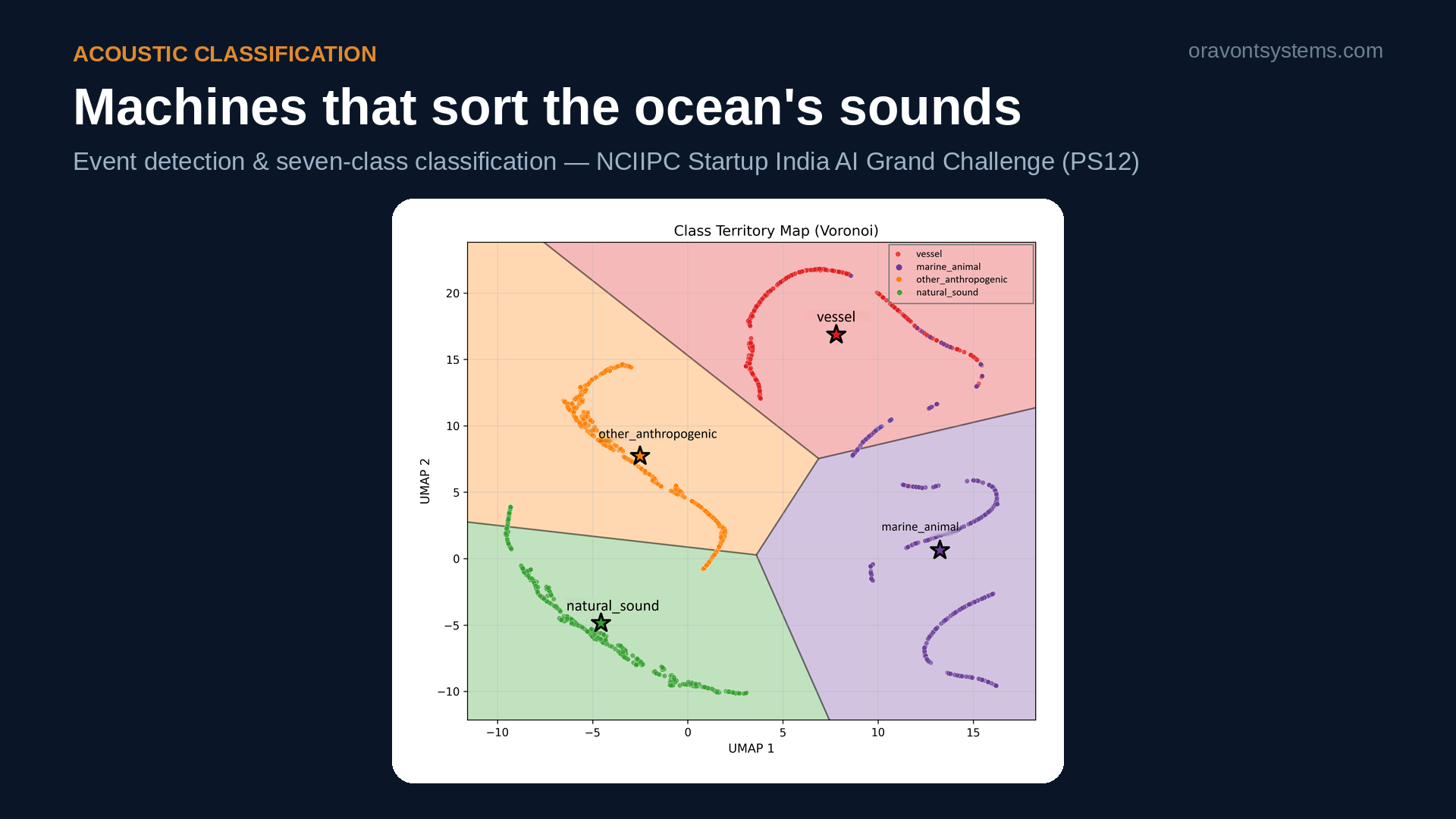
Seven acoustic classes — large and small vessels, whales, dolphins, other marine life, natural sound and other man-made sound — scored with calibrated per-class probabilities, and evidence aggregated within a recording before anything is reported.
Which hull?
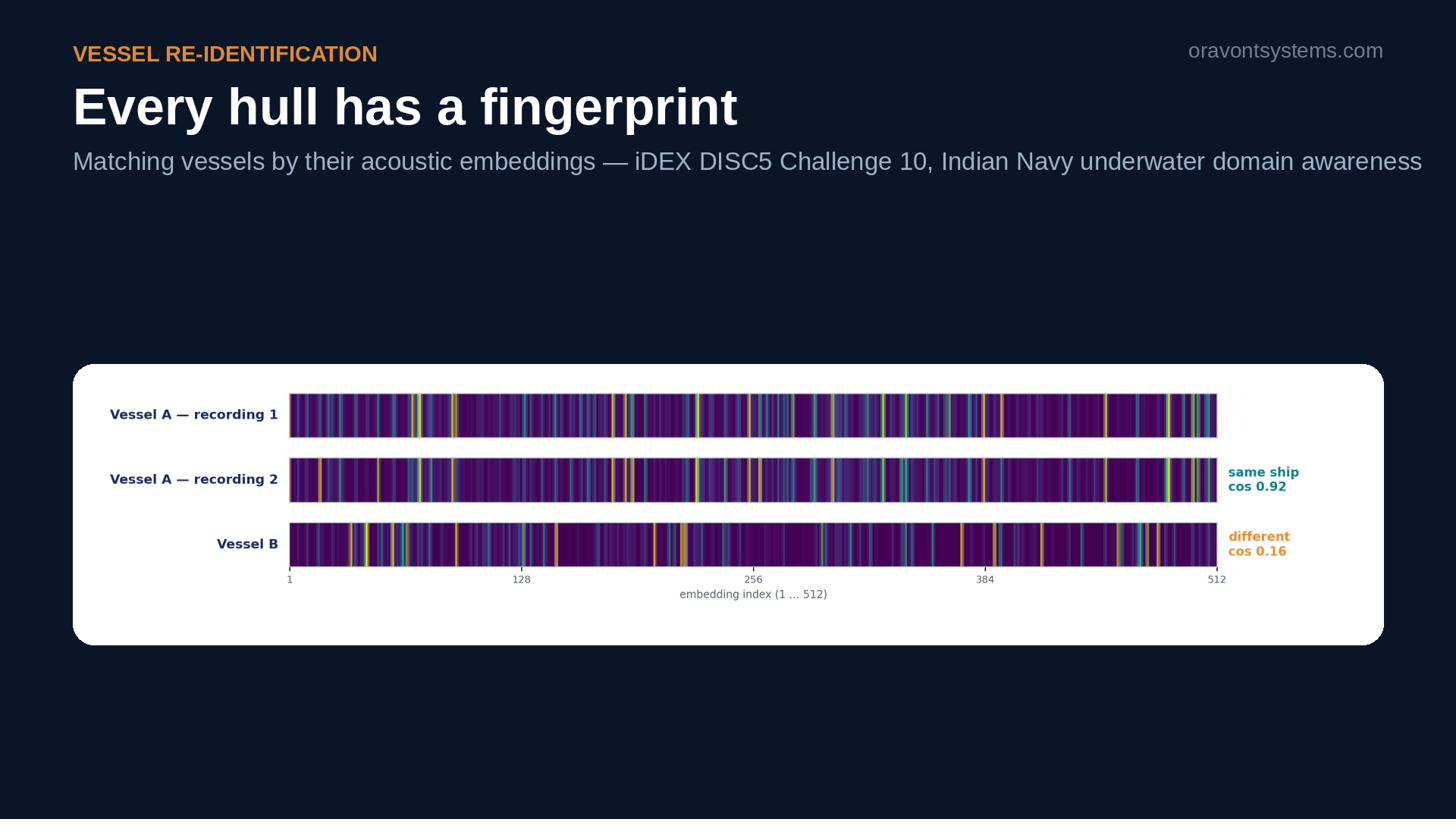
A compact acoustic fingerprint for each recording, compared by cosine similarity against an enrolled gallery: match to a known hull, or flag as new. Every comparison returns a number, so matches can be ranked and thresholded rather than re-judged by eye.
DEMON: the propulsion signature, read in the open
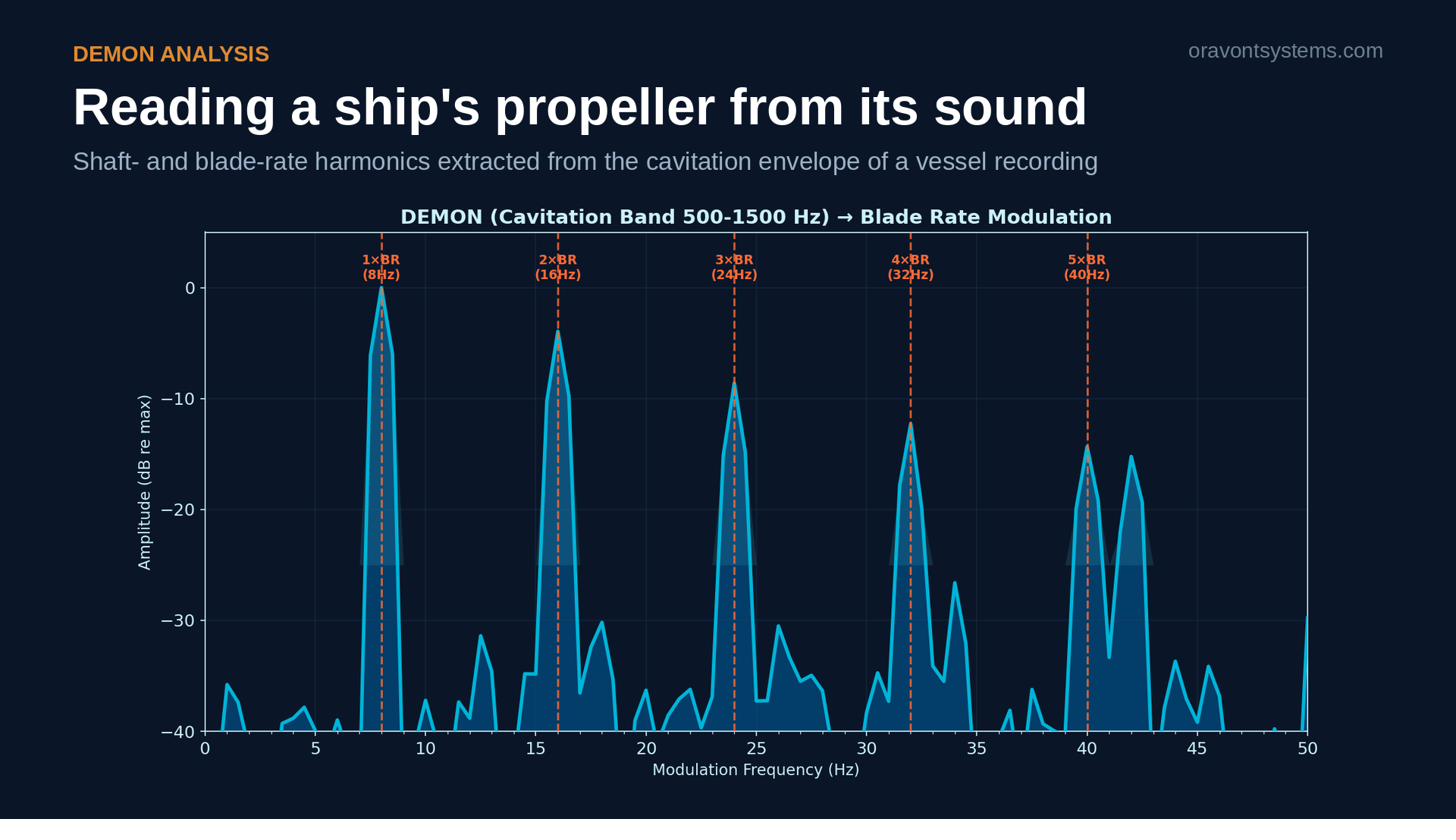
A vessel's propeller amplitude-modulates its own cavitation noise, and that modulation carries the propulsion signature. DEMON — Detection of Envelope Modulation on Noise — extracts it: bandpass the cavitation-dominated band, take the Hilbert envelope, and transform the envelope into a low-frequency modulation spectrum. Shaft-rate and blade-rate lines and their harmonics appear as a comb. Because blade rate equals shaft rate times blade count, the comb reads out shaft speed and an integer hull attribute — the number of blades — directly from the sound.
These interpretable, briefing-ready features run alongside the learned representations described on the Deep Learning track: two views of the same acoustics, one transparent, one propagation-robust. When an embedding model separates two recordings, DEMON often shows the physical reason — different blade rates, a different comb — in a form a review board can read.
The toolkit is open: DEMON-Analysis on GitHub (code under MIT; documentation, figures and samples under CC BY 4.0). The accompanying working note is on the Research page.
Programmes
PS12 — underwater acoustic event detection and classification Concluded May 2026
Under Problem Statement 12 of the AI Grand Challenge, Oravont designed an end-to-end system that takes raw hydrophone recordings and returns detected, classified acoustic events across seven target classes. Detection adapts to local ambient conditions; classification runs on SKANN with calibrated per-class probabilities; a runtime clustering stage aggregates evidence within each recording.
The pipeline was developed entirely on open-source acoustic corpora, runs offline on GPU or CPU, and produced strong, well-calibrated classification across acoustically diverse classes.
DISC5 Challenge 10 — vessel re-identification from passive sonar Active
Classification answers what kind of source is this. Re-identification answers a harder question: which specific vessel is this? As technical partner under DISC5, Oravont is building the deep-learning core that distils each recording into a compact acoustic fingerprint — a 512-number embedding trained with a metric-learning objective so that recordings of the same hull cluster together while different hulls separate.
A new contact is either matched to a known hull in the gallery or flagged as new — an open-set decision — and enrolling a vessel is a single forward pass, with no retraining and no new class.
Built for sovereign deployment.
- Frozen model, growing gallery — the user organisation enrols and scores on its own data, entirely in-house.
- No data egress, no retraining — fully offline operation on the user's infrastructure.
- Robust by design — training augmented with synthetic channel colouring, measured ambient noise, multipath and time shifts, so the fingerprint keys on the vessel, not the recording chain.
- Licence-clean — developed on open-source acoustic corpora with open-source dependencies; GPU-accelerated with CPU fallback.
Numbers an analyst can act on
Re-identification is only useful if its score means what it says. Oravont's evaluation protocol, published in the September 2026 preprint, closes the easiest routes to a flattering result: train and test splits that are disjoint by hull, keyed to vessel identity; galleries and queries drawn from separate passages of each hull; source-pure galleries, so that cross-corpus hardware signatures cannot act as a ranking shortcut; and an audio-adjudicated gate that merges recordings of the same physical transit before any score is computed.
On public data, transit deduplication alone removes a 16–21 point apparent rank-1 advantage — larger than the difference between the methods compared. The results support analyst triage over a ranked shortlist, not identification of record, and the practice says so in print. Details and figures are on the Deep Learning track and the Research page.
The other two tracks
SKANN is the engine
Both the seven-class classifier and the hull fingerprint come from the same idea: a learned multi-scale filterbank on the raw waveform, fused by selective-kernel attention, into a 512-dimensional embedding.
Open the track → 03 · StealthThe features a detector keys on are the ones stealth suppresses
Cavitation modulation and blade-rate lines are what DEMON reads; machinery tonals are what SKANN learns; all of them are what a stealth designer works to remove. Underwater-radiated-noise and target-strength models say what a detector should expect to hear.
Open the track →