
Six problems a quiet platform has to solve
01Acoustic modelling and underwater radiated noise (UWRN) estimation
A platform-level acoustic model of noise generation and propagation, and the total radiated noise it predicts under each operating condition.
- Structure-borne noise from vibro-active equipment and systems-pipeline noise.
- Airborne noise from vibro-active machinery.
- Propeller noise, including its interaction with the hull and appendages.
- Anechoic, sound-insulation and vibro-damping coating schemes, and mitigation strategies ranked by effect on the signature.
02Sonar signal reflection and target strength
How a hull returns active sonar, and how to return less of it. A vessel's reflection signature is governed by geometry, materials, coatings and structure.
- Decomposition of the hull and structures into simple reflective elements from line plans and structural data.
- Specular, diffuse and non-specular components, summed on an energy basis into the cumulative return.
- Effectiveness of anechoic coatings and structural modifications; recommendations on hull form, coatings and fittings.
- Submarines, surface ships and specialised naval platforms.
03Acoustic interference to own sonar
The noise a platform makes is also the noise its own sonar has to listen through. Interference is estimated at the sketch-design stage, so that mitigation is designed in rather than bolted on.
- Five components: radiated noise from the hull, machinery vibration, hydrodynamic turbulence, airborne noise, and structure-borne noise into the sonar.
- Frequency-specific modelling across the sonar's operating band.
- Noise isolation, vibration reduction and structural options, weighed against the sonar's detection performance.
04Airborne noise and habitability
Compartment noise levels during design, so that resting quarters and watchkeeping stations meet the staff requirements before the platform is built.
- Noise at specified locations within compartments, across octave bands from 31 Hz to 8 kHz.
- Contributions from machinery, ventilation systems and structural paths.
- High-noise zones identified early, with targeted damping and insulation changes.
05Shock, noise and vibration control
A safe, durable onboard environment for equipment and crew: the shock, vibration and noise limits that equipment must meet, and the mounting schemes that let it meet them.
- Shock-mounting scheme design; shock strength for equipment under underwater-explosion (UNDEX) loading.
- Vibration limits and isolation of machinery, systems and pipelines.
- Equipment noise and vibration limits, and measurement to validate performance against them.
06Mast vibration and design
Masts carry periscopes, sensors, antennas and electronic-warfare systems, and they sit in the flow. Vibration control keeps the sensors accurate, the signature down and the structure sound.
- Natural frequencies and resonance; the added-mass effect of the surrounding water.
- Vortex shedding and flow-induced vibration; steady and unsteady drag and lift.
- Stiffness, mass distribution and damping refinements; sensor and antenna performance under dynamic flow.
Engineering software
SSR-Sim
Simulates and analyses sonar signal reflections from submarine hulls and naval structures, for stealth design and research.
- Specular, diffuse and non-specular components.
- Frequencies, depths and relative bearings.
- Early-stage evaluation without physical prototypes.
ABNContour
Estimates and maps airborne noise in the compartments of ships and submarines during the design phase.
- Noise levels at specified locations; octave bands 31 Hz – 8 kHz.
- Contributions from machinery, ventilation and structure.
- Compartment noise profiles and high-noise zones.
SMS-Suite
Mathematical simulation and optimisation of shock-mounting systems for ship equipment: statics and dynamics at the design stage.
- Dynamic models from foundation, mass, body and mount elements, with automated equations of motion.
- Natural frequencies, static displacements, shock impulses, forced oscillations, quasi-static effects.
- 3-D visualisation; libraries of masses, mounts and impulses; CAD import (CATIA).
The tools are Oravont's own and are made available to defence organisations, shipyards and research institutions on enquiry through the Contact page.
Where this comes from
The practice's stealth work rests on its founder's six years as Head of the Acoustic Stealth Group at the Directorate of Submarine Design, Naval Headquarters (2015–21), with design authority for acoustic stealth, shock, noise and vibration across India's nuclear-submarine programme, on the sea and dockyard appointments that preceded it, and on the trials-and-acceptance appointment that followed. Work from that period, at the level it can be described publicly, includes:
- India's first indigenous submarine acoustic model, for predicting underwater radiated noise from machinery, propulsors and onboard systems.
- Re-creation of UWRN-estimation software in-house — structure-borne, airborne, propeller (with hull interaction) and systems-pipeline noise — removing the design office's dependence on proprietary tools.
- A standardised shock-mounting design methodology covering equipment centre of gravity, vacuum load, torque, tug-pull forces, mount compression under shock, roll and pitch effects and transmissibility.
- Statements of requirement for indigenous shock mounts, flexible inserts and vibro-damping coatings, and qualitative requirements for indigenous anechoic coatings.
- A submarine mast redesign that introduced vortex-shedding, resonance and added-mass assessment and a time-variant analysis of drag and lift forces.
- A shock-analysis tool that automates the estimation of shock amplitude and pulse width under UNDEX loading from the B-02 design curves.
The full record is on suniltyagi.in.
Why a stealth designer builds detectors
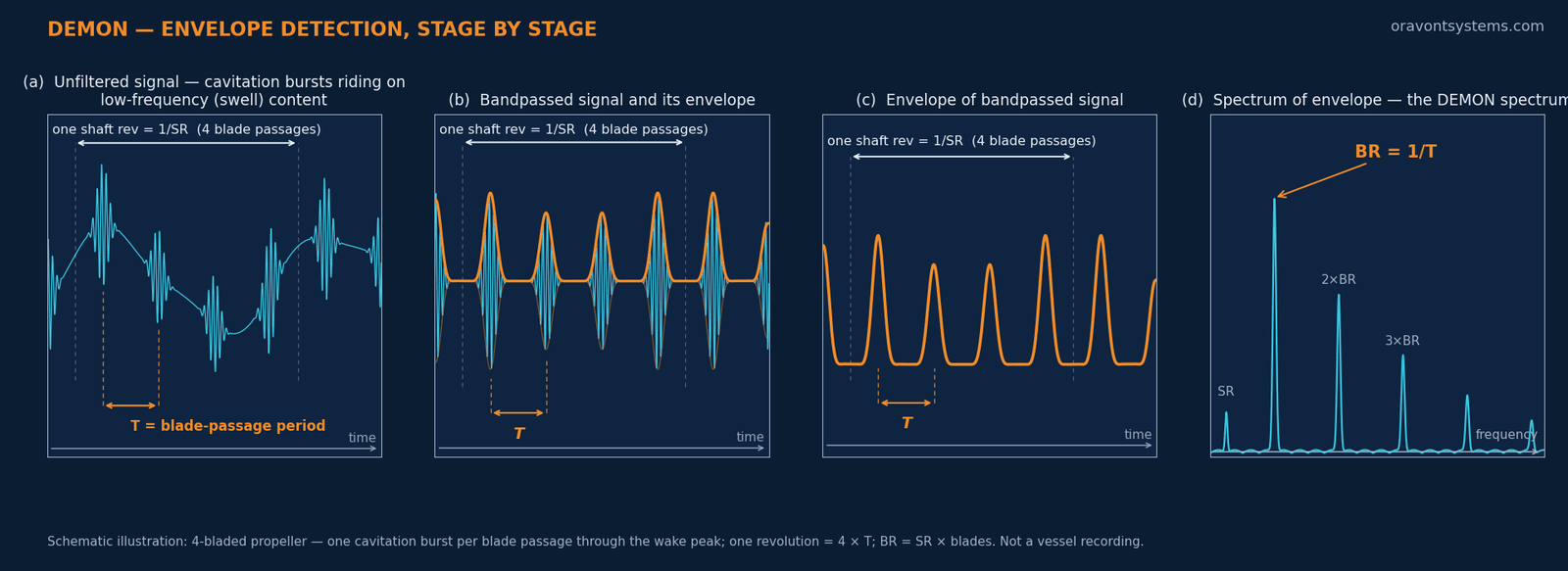
Everything a stealth designer suppresses is something a detector can key on. Cavitation modulated at the blade rate, machinery tonals at shaft and generator lines, flow noise over the hull: the UWRN model that predicts them for a design is the same physics that DEMON reads from a recording and that SKANN learns to represent. A target-strength model that says how a hull returns active sonar also says how detectable it is. Oravont works on both sides of that ledger deliberately, and each side sharpens the other.
Listening for what stealth suppresses
DEMON reads cavitation and blade-rate lines; SKANN classifies and re-identifies by the same signatures. The stealth models tell those systems what to expect to hear.
Open the track → 02 · Deep learningAcoustic modelling, reused as training data
The synthetic dataset and the augmentation regime are built from the same understanding of how machinery, propellers and hulls make noise.
Open the track →